
Modernizing Animal Bylaws
Overview
The Alberta SPCA is dedicated to advancing animal welfare proactively through advocacy, education, and by working alongside government, partners and Albertans to ensure animals receive the care and compassion they deserve. By standing up for Alberta’s animals and supporting their caregivers, we’re building healthier, safer communities for everyone.
One effective way to support both animal welfare and community well-being is through strong legislation, including thoughtful and compassionate municipal animal bylaws. These bylaws give communities the tools to protect people and animals alike.
When first introduced, animal bylaws primarily focused on public health and safety – mainly by controlling animals that were considered dangerous or a nuisance. Over time, however, Albertans’ relationships with animals have evolved. Pets are now widely regarded as family members, and our understanding of animal welfare and responsible guardianship has deepened. As a result, modern animal bylaws go beyond control. They also encourage compassionate, responsible care that reflects current values and community realities.
This information is designed to support municipalities and community leaders when developing or modernizing their local animal bylaws.
The Alberta SPCA continues to develop new tools and information to support municipalities in strengthening their animal bylaws. Sign up below to stay information as new resources become available.
Get Updates About New Animal Bylaw Resources
Shared Responsibilities for Animal and Community Well-Being
Animal welfare and community well-being in Alberta depend on the shared efforts of both the Alberta SPCA and local municipalities. While both play vital roles in protecting animals and people, their responsibilities differ in scope and authority.
Alberta SPCA
The Alberta SPCA enforces Alberta’s Animal Protection Act (APA) – provincial legislation that makes it an offense to permit an animal to be in distress.
Our Animal Protection Peace Officers:
- Investigate animal welfare issues involving domestic animals, including companion animals and livestock.
- Respond to concerns of animals in distress, including those without adequate food, water, shelter, veterinary care, or exposed to injurious heat or cold.
- Investigate the abandonment of animals, as defined by the APA.
- Provide education to pet guardians about their responsibilities under the APA.
- Work collaboratively with law enforcement and animal welfare organizations across Alberta.
- Have province-wide jurisdiction (however, don’t operate in the cities of Edmonton and Calgary).
- Can only investigate if we have reasonable and probable grounds to believe there may have been an offence under the APA.
What We Cannot Do:
- We do not enforce municipal bylaws, such as leash laws, barking complaints, or stray animal issues – those fall under the jurisdiction of municipal enforcement.
- We cannot investigate Criminal Code animal cruelty concerns, such as organized animal fighting, intentional poisoning, or bestiality – those are handled by RCMP or Police.
- We do not respond to wildlife concerns – those are handled by Alberta Fish & Wildlife or dedicated wildlife organizations.
- We do not respond to dangerous animal incidents – Unless there are concerns for animals in distress, these are handled by local enforcement agencies.
- We are unable to respond to emergencies or those involving public safety – residents should contact police or local enforcement.
- We cannot intervene in ownership disputes
- We are unable to investigate instances of animal neglect that occurred over 12 months ago, due the APA statute of limitations.
Alberta Municipalities
Municipalities play a crucial role in maintaining safe and healthy communities. They have the authority to create and enforce animal bylaws, which typically govern:
- Responsible pet guardianship and community safety.
- Licensing and identification.
- Leash and confinement requirements.
- Noise, nuisance, and waste management issues.
- Stray or roaming animal management.
- Impound procedures and shelter operations.
Through local enforcement, municipalities ensure that animal guardians meet basic standards of responsibility and that community members can coexist with animals safely and respectfully.
Working Together
The Alberta SPCA and municipalities both contribute to animal welfare and community safety. Strong municipal bylaws that encourage responsible pet guardianship help prevent neglect before it happens, complementing the Alberta SPCA’s enforcement of the Animal Protection Act. Collaborating ensures gaps in enforcement are minimized and that both people and animals benefit from consistent, compassionate standards.
Tip: To learn more about the various responsibilities of caring for animals in Alberta, explore the pathways in the “Have an animal concern?” menu of this website.
Alberta’s Evolving Pet Landscape
Over the past few decades, the percentage of Canadian households that care for a pet has grown and continues to trend upward. As of 2023, it was estimated that approximately 39-40% of Canadian households have a cat and 38-39% have a dog.
Alberta is no exception to this trend and in fact, leads Canada in pet guardianship rates. Nearly two thirds of Alberta households care for at least 1 pet, surpassing the national average of 57%.
The trend of welcoming pets into our homes shows no signs of stopping. Approximately one-third of Albertans expressed interest in wanting to get a pet in the next year, ranking them among the most likely in Canada to do so.
Beyond the increase in pet guardianship rates, Canadians’ relationships with animals are also evolving.
This growing recognition of the human-animal bond has reshaped expectations around animal care, community living, and the role of municipalities in ensuring animals, humans and the environment coexist in positive ways.
As attitudes continue to evolve, municipal animal bylaws must keep pace. They should move beyond simply regulating pet behaviour to supporting responsible guardianship and community well-being compassionately and practically.
5 Reasons Your Municipality Needs a Modern Animal Bylaw
1. Recognize Animal Interactions are Frequent
With over 60% of Alberta households caring for animals, interactions with them are a part of daily life. These interactions can have positive outcomes, such as improved mental health, or negative consequences, such as injuries from uncontrolled animals. Modern animal bylaws recognize this reality and help foster environments where people and animals can co-exist — whether at home or in the community.
2. Enhance Public Safety
Research shows that dogs exposed to early neglect, abuse or other adverse experiences are more significantly more likely to develop fear and aggression later in life, factors that often are associated with dog bites (Espinosa et al, 2025).
Clear rules for animal species that are not permitted (or require permits) and animal behaviour and care can help municipalities address issues like animal bites, roaming, and neglect. Proactive bylaws reduce risks and provide guidance when safety concerns arise.
3. Advance Animal Welfare
Modern animal bylaws play a pivotal role in supporting animal welfare at the community level. They promote responsible pet guardianship and set minimum standards for animal care, reflecting the reality that pets are increasingly regarded as family members. When animals’ needs go unmet, they can become a nuisance or pose risks to others. Updated bylaws recognize the connection between animal welfare and community safety.
4. Strengthen Community Well-Being
Well-cared-for animals contribute to safer, more connected, and compassionate communities. Bylaws that promote responsible pet guardianship reduce neighbour conflicts, support positive human-animal interactions, and improve overall quality of life.
5. Reflect Evolving Community Needs
Effective bylaws address current community realities such as multi-pet households, overpopulation, free-roaming animals, allowing livestock in urban areas, and shifting community expectations. Modernizing ensures bylaws remain relevant and responsive
Key Elements of a Modern Animal Bylaw
Effective animal bylaws balance both the control and care of animals, as well as the needs of each community.
Modern animal bylaws focus not only on controlling animals, but they also emphasize the requirements of people to responsibly care for animals. A modern animal bylaw recognizes that animal welfare, public safety, and community well-being are interconnected.
The Alberta SPCA recommends that municipalities review the unique needs of their community and consider the following elements when reviewing or developing their animal bylaws.
Disclaimer: The information provided on this page is intended to act as guidance for municipalities considering updates to their animal bylaws. These are suggestions and considerations, not legal requirements. Each community is unique, and municipalities should make decisions that best reflect their local needs, resources and priorities. We encourage municipalities to seek professional advice and consider relevant legislation when developing or updating animal bylaws.
Animal Species to Include
Guidance for Municipalities
- Recognizing that animal guardianship varies across Alberta, communities may wish to reflect on species that are prevalent or pose unique challenges locally.
- Consider both dogs and cats.
- Municipalities may wish to define “animal” broadly while allowing for species-specific regulations as needed (e.g. off leash dog parks, areas permitted for livestock).
- Consider whether regulations or restrictions specific to livestock, backyard hens, pigeons, bees, or wildlife are also needed for your community.
Rationale & Other Considerations
- Dogs and cats are the most common pets, therefore most animal bylaws are focused here.
- Despite residing in households at nearly equal rates as dog, many bylaws still omit or only partially address cats.
- Including both dogs and cats promotes equal responsibility, setting the expectation that both species should be valued and cared for.
- Including regulations for cats provides tools for common community issues such as roaming, property damage, and wildlife predation.
- Roughly 7% of Canadian households also care for other pets – small mammals, birds, reptiles or fish.
- A broad definition of “animal” allows bylaws to cover less common pets that may still pose risks. For example, if a resident were to bring a large snake to a school playground, the bylaw could prohibit it, provided it restricts all animals – not only dogs – from designated areas.
Across Alberta
Most animal bylaws in Alberta focus on domestic pets, with nearly all covering dogs. Medium to large municipalities frequently include cats as well, however they are not included consistently. Provisions for keeping urban livestock, such as hens or bees, as well as pigeons and occasionally, rabbits, are also included in some bylaws. Small municipalities are more likely to only include dogs in their bylaws, and/or define animals more narrowly.
Some municipalities also include a list of prohibited animal species in their community. It should be noted that there are also several provincial laws that prohibit the keeping of certain animal species (usually wildlife or exotic), and are enforced by Alberta Environment and Parks (Fish and Wildlife Division):
- Wildlife Act: Maintains a Controlled Animals List, specifying species that are prohibited in the province or require permits for possession or import.
- Public Health Act - Includes regulations that restricts the ownership and distribution of certain wildlife species (bats, raccoons, skunks, turtles and some birds).
- Agricultural Pests Act – Includes regulations that restricts the possession of certain species, such as rats, under pest and nuisance control.
Example Bylaws in Effect
Lethbridge Animal Care and Control Bylaw (2025 Update)
- “Animal” is defined as any reptile, bird, amphibian or mammal excluding humans.
- Includes sections on the regulation of animals, as well as sections specific to the regulation of dogs, cats, pigeons, wildlife and livestock.
- Introduced new cat regulations in 2025 to address community feedback about nuisance cat behaviour.
Animal Limits
Guidance for Municipalities
- Communities may consider setting reasonable limits on the number of animals permitted per household or municipal address.
- Consider allowing residents to apply for excess animal permits when appropriate.
- Consider exceptions for licenced facilities when applicable (veterinary clinics, boarding facilities, humane societies, zoos, etc.).
- Separate limits could be considered for dogs, cats, and other animals – especially those that reproduce quickly such as rabbits.
- When setting species-specific animal limits, we recommend that social animals such as dogs, rabbits and guinea pigs, be permitted to reside in pairs.
- Exclude juvenile animals under the age of sexual maturity (typically 3-5 months) from limits.
- We encourage a compassionate, practical, and lenient approach to enforcement of animal limits.
Rationale & Other Considerations
Support Animal Welfare, Community Health & Public Safety
Animal limits can help address welfare issues early on. Issues such as animal hoarding and the irresponsible breeding and sale of animals are two common issues that can significantly impact animal welfare and community well-being.
Species-specific limits also account for social and behavioural needs. For example, dogs, cats, and even rabbits are social animals that can thrive in pairs.
Establishing animal limits at a municipal level may also empower municipalities to take meaningful action where gaps in enforcement may exist. For example, provincial Animal Protection Officers may be limited in their enforcement abilities under the Animal Protection Act unless clear signs of distress are observed as a result of the high animal numbers.
High numbers of animals can also lead to unsanitary conditions, increased disease transmission, as well as noise and odour complaints. By setting reasonable limits, municipalities have the potential to act proactively and compassionately protect animals and people.
Determining the Number of Animals Permitted
There is not necessarily a straightforward number of animals to permit. Rather, this is subjective and may vary depending on the geographical layout of a community, size and type of animal, size of the property, as well as the individual caregiver’s capacity to provide responsible care. Therefore, the number that best suits your municipality will likely need to be determined by community leadership.
Juvenile Animals
Municipalities should consider the age of the animal at which the animal limit applies. Most communities exclude young animals under a certain age (typically ranges from 3-6 months) towards the animal limit.
Some communities specify that puppies and kittens not included in the total animal limits must be the progeny of a licenced adult dog/cat in the household. While this may appear to be a helpful tool in deterring irresponsible breeding and sale of animals, it is important to recognize that there may be instances where an unmothered litter is reliant on the care of humans and/or still benefiting from the socialization of their littermates.
Exceptions
Allowing flexibility through excess animal permits helps to acknowledge that not all situations are alike. Examples may include, but are not limited to:
- Residents relocating to the municipality with existing pets.
- Humane societies or other animal care/boarding facilities.
- Licenced veterinary clinics, education or research facilities.
Municipalities may want to consider including the ability for officers to inspect premises in order to approve exception.
Enforcement
If a caregiver is providing responsible care for their animals, despite being over the limit, it may be reasonable to encourage that person to apply for an excess animal limit or its equivalent, rather than receive a fine or be forced to part with their animal to avoid penalties.
This approach recognizes the importance of the human-animal bond and why it is often of the best interest to both the animal and the caregiver to remain together in the absence of concerns for animal welfare or public safety.
Across Alberta
Approaches to animal limits varies across the province.
- Limits on dogs are common, ranging from 2-6 per municipal address.
- When included, limits for cats are either the same or higher than the number of dogs permitted, with maximums for cats reaching 6 more commonly than for dogs.
- Some municipalities specified a maximum number for dogs, as well as for cats but did not allow for the total number of animals at a municipal address to surpass a specified quantity.
- Some municipalities specified a reduced total animal limit if one of the animals was deemed to be aggressive/restricted/aggressive.
- The size of the property was taken into consideration in some municipalities.
Example Bylaws in Effect
City of Lloydminster - Domestic Animal Bylaw, 2020:
“No residential household shall have more than five (5) Dogs, or five (5) Cats, or
one (1) Restricted Dog or combination thereof to a maximum of five (5) Domestic
Animals in total, residing in any residential household within the City of Lloydminster.”
Strathcona County - Responsible Dog Ownership Bylaw:
“Unless an over-limit permit is issued to a person for a residence, that person may not keep, allow, suffer or permit more than the following number of dogs to reside or remain at a County residence:
(a)Not more than three (3) dogs, for residences of five (5) acres or less; and
(b)Not more than five (5) dogs for residences over five (5) acres.”
Licencing & Identification
Guidance for Municipalities
- Consider implementing a municipal pet licencing or registration program when it is practical for the community and designed with both animal welfare and community well-being in mind.
- Consult with residents and local stakeholders to determine the most effective and compassionate approach.
- Ensure there are accessible systems for licence applications, renewals, and updates.
- Include regular public education campaigns that highlight the benefits of licensing your pet, application and renewal details, and the importance of keeping information current.
- When a licencing program is not practical, municipalities may wish to prioritize requirements for animals to have identification.
- Consider requiring visible identification (e.g., tags worn on a collar or harness) when animals are off their guardian’s property to make it easier for lost animals to be returned home quickly.
- Encourage the regular use of visual identification, combined with permanent identification methods (registered microchips, legible tattoo) for the greatest chance of reunification.
- Consider linking each pet’s permanent identification details (e.g. microchip number) to their municipal licence for increased probability of quick and reliable tracing.
- Special licensing requirements for where animals are bred or sold, with provisions for inspection when appropriate, could help ensure animal welfare standards are being met.
Rationale & Other Considerations
Effective animal licencing programs can help municipalities:
- Protect animal welfare by facilitating the fast and safe reunification of lost pets with their guardians.
- Reduce stress, fear, and anxiety for both animals and their caregivers when pets go missing.
- Limit the time animals spend in shelters or impound facilities, improving their welfare and reducing care costs.
- Provide data on the number and type of animals in the community, helping to plan for services that support both animal and public well-being.
- Assist first responders during emergencies by identifying where animals reside.
Licensing Program Options
There are multiple ways a municipality could design an animal licensing or registration program. Each has unique benefits and challenges that may be influenced by other factors. The best approach depends on the unique needs and factors that exist in your community.
We recommend municipalities review their relevant community challenges and needs, as well as their available resources, and consider the following approaches:
Mandatory Licensing
Strengths:
- Can improve the ability to reunite lost animals, since licensed pets can be traced quickly, provided information has been kept current.
- Increases baseline compliance when the requirement to license can be enforced, especially when penalties or fines exist. See Calgary.
- Generates revenue that can support animal service operations and other animal welfare initiatives.
- Provides more accurate data about the size and distribution of pet populations, enabling better planning for municipalities.
- Increases accountability for pet guardianship, reinforcing responsible care.
Challenges:
- Potential for lower compliance if fees are high or if enforcement is inconsistent.
- High fines or fees may discourage reclaiming lost pets, prolonging their shelter stays.
- Increased costs related to enforcement, education, public outreach and reminder systems, which are typically necessary to have an effective mandatory licensing program.
- Low-income households may be disproportionately affected by licensing fees or enforcement penalties. This may be mitigated with reduced fees or discounts for specific circumstances.
Licencing Fees
Licensing fees can be a source of revenue to fund animal services and enforcement. However, higher fees may be perceived as a barrier to licensing an animal, especially if enforcement is lacking or perceived benefits are low.
Offering lower fees, incentives, or free licensing for certain categories (seniors, low income, spayed/neutered pets, therapy animals) can help increase program participation rates.
Lifetime vs. Annual Renewals
Annual Renewals:
- Municipalities could adjust yearly fees as needed to account for changing costs or inflation.
- Creates yearly contact points for education on animal care and responsibility.
- Encourages guardians to keep identification and contact information up to date, improving the likelihood of lost pets being safely returned.
- Provides municipalities with current data to support animal and community service planning.
Lifetime Licensing:
- Helps to reduce administrative burdens and makes compliance easier for guardians.
- May improve participation by simplifying the licensing process.
- May be best suited for smaller communities or those with limited administrative capacity.
- Pairing lifetime licensing with a simple annual information update could help maintain accurate data and ensure information stays current.
For more information see Pet Licensing in North America Research Report (2019).
Across Alberta
There is a range of approaches to licencing and identification requirements across Alberta, demonstrating there is likely no single “right” model.
Larger cities like Edmonton and Calgary have licencing requirements for both dogs and cats, offer online renewals, reduced fees for spayed/neutered pets, have tag identification requirements, and utilize active enforcement and fines. Licensing revenue supports their animal services and both municipalities offer a free “ride” home if a licenced pet is found at large off their guardian’s property.
Medium-sized municipalities (e.g. Red Deer, Lethbridge, Canmore, etc.) are often similar to larger cities (annual mandatory licences, tag requirements, spay/neutered discounts), but fee levels, administration, and program details vary. Some municipalities have licencing requirements for dogs but not cats. When cats are not included in licencing requirements, they may still be required to have identification when off their guardian’s property. Some municipalities contract with local humane societies to administer registration/renewals or shelter services.
More variation is seen in small municipalities; however, many still require annual licences or offer lifetime licence options. Some towns are moving away from licences entirely but now require visible ID on collars instead (e.g. Okotoks).
Example Bylaws in Effect
City of Calgary - Responsible Pet Ownership Bylaw
- “Licences Required
3. (1) A Person must not own or keep any dog within the City without a valid and subsisting dog licence for that dog.
(2) A Person must not own or keep any cat within the City without a valid and subsisting cat licence for that cat.”
- “Responsibility of Owners to Ensure Proper Licensing
8. (2) An Owner of a licensed Animal must:
a) ensure that such Animal wears a Tag whenever the Animal is taken by the Owner off the property of the Owner as evidence of the valid and subsisting licence purchased for that Animal;
(b) ensure that such Animal has a valid and subsisting licence at all times by applying for and renewing the licence in accordance with this Bylaw;
(c) obtain a licence on the first day on which the Animal Services Centre is open for business after becoming the Owner of the Animal;
(d) obtain a licence for the Animal notwithstanding it is under the age of three months where the Animal is found Running at Large; and
(e) obtain a licence on or before the day specified by the Animal Services Centre as the expiry date of the licence that corresponds to that Animal.
(3) An Owner of an Animal may, in place of ensuring the Animal wears a Tag pursuant to subsection 2(a) above, ensure that the Animal bears a visible tattoo or microchip that identifies the Animal and Owner.
(4) An Owner of a licensed Animal must notify the Animal Services Centre forthwith of any changes to the Owner’s mailing address and phone number so that this contact information is kept current at all times.”
- Also have an urban livestock licensing program for the keeping of bee colonies, pigeons, and hens.
Fort McKay First Nation – Responsible Pet Owner Bylaw
- “4.1 Every Dog and any other Animal that the Council has determined, by Band Council Resolution, must be registered under this By-Law, shall be registered by the Owner.”
- “4.3 The charge for registration and identification tags shall be $10.00 dollars per year per Animal or such further or other amount as may be designated by the Council, from time to time, by Band Council Resolution.”
- “4.4 The Animal Control Officer shall issue the license tag upon registration and payment of the annual fee and, if necessary, proof that the Animal has been immunized against rabies.”
- “4.5 In the case of a Dog, the license tag shall be securely attached to the collar or harness of the Animal at all times and in all other cases the Owner shall be responsible for the production of the license tag upon the request of the Animal Control Officer. 4.6 The registration and identification tag will be valid for one full year from the date of issuance.”
Animal Care Standards
Guidance for Municipalities
- Consider including minimum standards of care within municipal animal bylaws.
- Explore the development of clear requirements that promote both the physical and mental well-being of animals.
- Municipalities are encouraged to align animal care standards with the Five Domains of animal welfare: nutrition, environment, health, behavioural interactions and mental state.
- Consider provisions that allow for enforcement action when animals are deprived of care standards, such as adequate food, water, shelter, space, ventilation, light, exercise, sanitation and veterinary attention.
- Engage local stakeholders when developing standards to ensure they are practical and relevant to the community.
References: Understanding the Five Domains Model of Animal Welfare.” The Jeanne Marchig International Centre for Animal Welfare Education, University of Edinburgh, 2024. PDF. Available at: https://vet.ed.ac.uk/sites/default/files/2024-09/5%20Domains%20Model.pdf
Rationale & Other Considerations
- Establishes community expectations for responsible animal care.
- Prevents animal welfare issues from escalating to situations requiring intervention under the Animal Protection Act.
- Taking proactive steps to ensure animals are properly cared for can help prevent nuisance behaviours, such as excessive barking, and safety risks, including aggression or dog attacks, which are often associated with inadequate care (van Herwijnen et al, 2023; Kinsman et al, 2025).
- Behavioural problems, including excessive barking, are associated with negative emotions and decreased life satisfaction in animal caretakers (Barcelos et al, 2024). Addressing these issues through responsible care can improve both animal welfare and guardian well-being.
- Gives local authorities tools to address inadequate care practices.
- Promotes consistent understanding among residents, enforcement officers and animal guardians of what constitutes acceptable care.
- Encourages education and compliance, creating a culture of compassion and responsibility in the community.
References:
Barcelos, Ana Maria, Niko Kargas and Daniel Mills. "The Effects of Dog Behavioural Problems on Owner Well-Being: A Review of the Literature and Future Directions." Pets, vol. 1, no. 1, 2024, pp. 53–69. https://doi.org/10.3390/pets1010007
Kinsman, R.H., Rachel A. Casey, Sarah Tasker, Becky Cooper, Kristina Giragosian, Naomi D. Harvey, Sylwia C. Owczarczak-Garstecka, L. Samet, and J.K. Murray. “Owner-Perceived Undesirable Behaviours in Young Dogs and Changes with Age.” Animals, vol. 15, no. 8, 2025, p. 1163. https://doi.org/10.3390/ani15081163
van Herwijnen I.R., van der Borg J.A.M., Kapteijn C.M., Arndt S.S., Vinke C.M. “Factors regarding the dog owner’s household situation, antisocial behaviours, animal views and animal treatment in a population of dogs confiscated after biting humans and/or other animals.” PLOS ONE, vol. 18, no. 3, 2023, e0282574. https://doi.org/10.1371/journal.pone.0282574
Across Alberta
Several Alberta municipalities have adopted animal care standards in their municipal animal bylaws to complement provincial legislation and strengthen local animal welfare. Some municipalities also make it an offence to allow an animal to be in distress or to commit acts such as teasing or harassing an animal.
Example Bylaws in Effect
City of Airdrie - Animal Control Bylaw:
- “Giving Basic Care to Animal
5.1 An Owner of a Domestic Animal must ensure that the Domestic Animal receives food, water, shelter and exercise sufficient to maintain the Domestic Animal in good health.
5.2 An Owner of a Domestic Animal must provide the Domestic Animal with adequate care when the Domestic Animal is wounded or ill.”
- “Tease, Torment or Annoy an Animal
7.3 No Person shall tease, torment or annoy a Domestic Animal.”
Regional Municipality of Wood Buffalo - Responsible Pet Ownership Bylaw:
- “An owner shall ensure an animal is provided with:
30.1. potable water; 30.2. species-specific food; 30.3. sanitary food and water receptacles;
30.4. regular opportunity for exercise sufficient for the wellbeing of the animal;
30.5. a clean and sanitary shelter, enclosure or living area; and
30.6. veterinary care to relieve or prevent pain when the animal exhibits any signs of pain, injury, illness or suffering, including prompt veterinary care for any potential Infectious Physical Condition.”
- “32. An owner shall ensure that an outside animal is provided with:
32.1. a shelter that protects from wind, heat, cold, wet and the direct rays of the sun; a shelter that is structurally sound;
32.3. a shelter that is sanitary;
32.4. a shelter that is sufficiently large to allow the animal to easily and comfortably stand, turn and lie down; and
32.5. continuous access to unfrozen potable water and species-specific food.”
City of Spruce Grove - Responsible Pet Ownership Bylaw:
- “4.6 No person or owner shall cause or permit an Animal to be in distress”
Town of Taber - Dog Control Bylaw:
- “3.1 The Owner of a Dog shall ensure that such Dog will not:
3.1.9 be neglected. This includes, but is not limited to, providing adequate food, water, shelter, veterinary care, and attention.”
Siksika Nation - Dog Care and Control By-law:
- “22.01 No Person shall tease, torment or intentionally provoke a Dog.”
- “22.02 No Person shall punish or abuse a Dog in a manner that is cruel, unnecessary or that is likely to cause the Dog negative psychological consequences.”
- “25. 01 An Owner of a Dog must ensure:
(a) that the Dog receives food, water, shelter, proper veterinary care and exercise sufficient to maintain the Dog in good health; and
(b) that the area of the Owner's Property where the Dog is kept is at all times maintained in a clean, sanitary and inoffensive condition.”
Unattended Animals (Abandoned Animals)
Guidance for Municipalities
Municipalities are encouraged to consider the inclusion of municipal regulations that prohibit leaving animals unattended in public places.
Rationale & Other Considerations
As per the provincial Animal Protect Act (APA):
“An ‘abandoned animal’ includes an animal that
(a) is left for more than 24 hours without adequate food or water or shelter,
(b) is left for 5 days or more after the expected retrieval time from a registered veterinarian or from a person who for money consideration or its equivalent stables, boards or cares for the animal, or
(c) is found on premises with respect to which the tenancy agreement has been terminated.”
While peace officers have the authority under the APA to investigate cases of abandonment, abandonment itself is not a standalone chargeable offence. This limitation can result in enforcement gaps and delays in addressing animal welfare when circumstances do not meet the strict definition of abandonment.
By including a clear municipal prohibition on leaving animals unattended in public places, municipalities can help:
- Protect public safety: Unattended animals may pose risks such as aggressive behaviour, traffic hazards, or attracting other animals, potentially leading to incidents that threaten public safety.
- Enhance animal welfare: Animals left unattended may experience stress, injury, or exposure to extreme weather.
- Improve enforcement efficiency: Municipal regulations can empower local authorities to respond swiftly to instances of unattended animals, ensuring timely intervention and reducing enforcement gaps.
Across Alberta
Approaches range across the province, with some municipalities explicitly prohibiting leaving animals unattended in public, while others address abandonment directly within their bylaws – sometimes including a formal definition.
Example Bylaws in Effect
City of Calgary – Responsible Pet Ownership Bylaw:
- “16. (1) The Owner of an Animal must ensure that such Animal is not left unattended while tethered or tied on premises where the public has access, whether the right of access is express or implied.”
City of Lethbridge – Animal Care and Control Bylaw:
- “21 No Person shall abandon or leave any Animal unattended in a public place.”
Siksika Nation – Dog Care and Control By-law:
- “2.01 In this By-law, unless the context otherwise requires:
(a) "Abandoned" means any Dog that is:
(i) left for more than 24 hours without adequate food, water or shelter;
(ii) left for five (5) days or more after the expected retrieval time from an Animal Control Facility;
(iii) found on Premises which have been vacated by the Owner; or
(iv) is found At Large on more than three (3) occasions.”
- “25.04 An Owner of a Dog must not Abandon the Dog”
Animals Left in Vehicles
Guidance for Municipalities
Municipalities are encouraged to consider the inclusion of municipal regulations regarding animals left unattended in vehicles, as well as explore enforcement authorities to remove animals from dangerous scenarios when needed.
Rationale & Other Considerations
Every year municipalities across Alberta are faced with situations where pets are left unattended in vehicles. In many cases, animal guardians may be unaware of the risks or how quickly these situations can become dangerous. Clear bylaw provisions can empower municipalities to respond proactively and ensure appropriate enforcement when animals are left in unsafe conditions
Leaving an animal unattended in a vehicle can create both animal welfare and public safety concerns, including:
- Exposure to injurious heat or cold.
- Inadequate ventilation.
- Lack of access to water.
- Risk of animal or vehicle theft.
- Aggressive or defensive animal behaviour directed toward the public if animals are not adequately secured in the unattended vehicle.
While the Alberta SPCA is authorized under the Animal Protection Act (APA) to remove animals that are in distress, our officers are not resourced to respond to emergent situations and cannot issue tickets to guardians. Similarly, while police and RCMP can intervene, they must also prioritize these calls with other emergencies. As a result, addressing animals left in vehicles often requires a coordinated, multi-agency approach in which municipalities play a key role through local regulations and enforcement.
The APA specifies that animals must have access to an adequate shelter and unfortunately, a vehicle does not always guarantee this. Temperatures inside vehicles can rise rapidly, even on mild days, and often exceed outside temperatures. In winter, vehicles can retain cold and act like refrigerators, placing animals at risk of hypothermia. It’s also important to consider that even vehicle climate control systems can fail.
Opening the windows or tethering an animal to the outside of a vehicle are also ineffective and often unsafe solutions. Opened windows do not provide sufficient temperature control, and tethering animals outside vehicles can lead to injuries or uncontrolled interactions with people or other animals.
To effectively protect both animals and the public, municipalities should consider training local enforcement officers on how to recognize signs of distress in animals due to heat, cold or confinement.
Across Alberta
There are several Alberta municipalities that include sections in their bylaws to address animals left unattended in vehicles. These bylaws often include references to extreme temperatures or during hot/cold weather, recognizing that vehicles can become dangerous quickly. There are often requirements for ensuring the animal is restrained such that they can’t interact with people or other animals, and that the vehicle must offer proper ventilation and water to prevent distress.
However, there are still gaps among municipalities. Some municipalities do not yet have specific wording about animals in vehicles. Instead, they may refer generally to animal neglect but not explicitly to animals left unattended in vehicles. Some bylaws only mention hot weather or “extreme” temperatures, and some only include dogs and not other species.
Example Bylaws in Effect
City of Calgary – Responsible Pet Ownership Bylaw:
- “16(4) The Owner of an Animal left unattended in a motor vehicle must ensure:
(a) the Animal is restrained in a manner that prevents contact between the Animal and any member of the public; and
(b) the Animal is not confined in such a manner that places it in a life or health threatening situation by exposure to a period of extreme heat or cold, without proper ventilation or other protection from such heat or cold.”
City of Lethbridge – Animal Care and Control Bylaw:
- “20(1) The Owner of an Animal left unattended in a motor vehicle must ensure:
(a) the Animal is restrained in a manner that prevents contact between the Animal and any member of the public; and
(b) the Animal has suitable ventilation.
(2) Notwithstanding section 1(b), the Owner of an Animal must not leave an Animal unattended in a motor vehicle when the temperature outdoors is below minus fifteen(15) degrees Celsius or above twenty (20) degrees Celsius except where the motor vehicle has an active running climate control system. ”
Town of Canmore – Animal Control Bylaw
- “43 An Owner of a Domestic Animal left unattended in a Motor Vehicle shall ensure the Domestic Animal:
(a) is restrained in a manner that prevents contact between the Domestic Animal and any Person, Wildlife, or Domestic Animal;
(b) has suitable ventilation and water; and
(c) is not endangered by weather conditions.”
Recommendations are updated frequently. Sign up for email updates.
When Resources Are Limited
Practical ways to make a meaningful impact in your community.
The Alberta SPCA recognizes that every municipality in Alberta is unique. Population size, geography, budget, and local priorities all influence a municipality’s ability to develop, implement, and enforce an animal bylaw. Even when resources are limited, there are still effective ways to promote responsible animal guardianship and address animal welfare concerns within the community.
Across Alberta, relationships with animals are evolving, and rates of pet guardianship continue to rise. This means daily interactions between people, animals and the broader environment are becoming increasingly common. Municipalities play a key role in shaping these relationships – not only through enforcement, but through effective education, collaboration and prevention.
While not every municipality can independently operate an animal services facility, hire a full-time enforcement team, or adopt a comprehensive bylaw right away, there are innovative and community-driven alternatives that municipalities are encourages to explore to help enhance well-being and safety for both animals and people in their communities.
Impactful approaches to consider:
- Partnering with local organizations such as veterinarians, boarding facilities or regional animal shelters to share or contract resources or create referral pathways for animal-related concerns.
- Implementing targeted bylaws that address the most pressing local issues as a first step toward a more comprehensive framework.
- Offering community education campaigns to raise awareness about responsible pet guardianship, licensing benefits, and animal care expectations.
- Collaborating regionally with nearby municipalities to share enforcement or sheltering services, reducing individual costs while improving outcomes.
- Encouraging voluntary compliance through positive reinforcement strategies, such as incentives for licensing, low-cost spay/neuter initiatives, microchip programs or partnerships that make pet care more accessible.
Real World Examples
Provides animal services (bylaw enforcement, education, sheltering, lost pet reunification) via contracts with the City of Red Deer, Town of Stettler, Red Deer County and Clearwater County. They also facilitate an adoption program for unclaimed animals with partner animal rescue groups.
Lethbridge Microchipping Program
When the City of Lethbridge was looking to update their Animal Care and Control Bylaw 6475, public survey results showed that 79% of respondents identified the need to regulate cats in the community. As an alternative to mandatory cat licensing, which they determined would not be feasible for their municipality, they opted to implement a public low-cost microchipping program. For cats, a $30 fee would cover the cost of the microchip and implantation, as well as a voluntary cat licence with the city. The program is cost-neutral for the city and the goal of the program is to help with guardian identification and improving reunification rates.
Ten Steps to a Modern Animal Bylaw
Communities looking to introduce or update an animal bylaw may be wondering how and where to start. Because each community is unique, there is no single process that is likely to work for everyone.
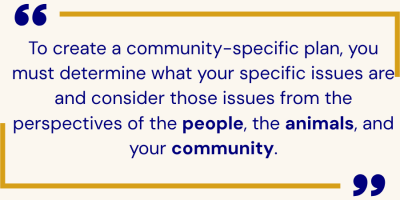
Epp, T. & Dhillon, J. (2018). The Community Dog Book. University of Saskatchewan, Western College of Veterinary Medicine
The following steps are meant to provide general guidance and considerations to help municipalities move forward confidently. They are aligned with best practices under Alberta’s Municipal Government Act and Alberta Municipal Affairs’ guidance for bylaw development. Following a structured and transparent process helps ensure bylaws are enforceable, community-supported and reflective of local needs.
We also encourage communities to share their experiences of implementing a new animal bylaw. By learning what has worked (or what hasn’t), we can learn from one another as we collectively aim to strengthen animal welfare and community well-being across Alberta.
Share your experiences with us: [email protected]
Before You Begin
Start by reflecting on your community’s context and available resources.
What resources are available to you?
- Budget and funding opportunities.
- Administration and enforcement capacity.
- Availability of enforcement partnerships or shared services.
- Access to animal control or shelter services.
- Availability of animal care supports (e.g. local humane societies, veterinarians).
- Capacity to educate and communicate new bylaw requirements.
- Access to community-specific, animal-related data.
What community-specific issues could an updated bylaw help address?
- Urban municipalities: Pet density, nuisance complaints, off-leash parks, licensing programs.
- Rural municipalities: Livestock, working dogs, feral or roaming animal challenges, shared enforcement resources.
Other factors to consider:
- Local attitudes and cultural perspectives.
- Relevant stakeholders and their roles.
- Plans for long-term evaluation and updates.
Step 1: Identify the Need
- Determine whether your municipality already has an animal bylaw and if so, the date in which it was last updated.
- Review its contents and identify areas that may no longer reflect community values or current best practices.
- Review the information and recommendations on this page.
- Make note of what’s missing and where updates could strengthen public safety, animal welfare, or enforcement clarity.
Step 2: Public Engagement – Phase I (Open Feedback)
Goal: Identify what matters most to residents in your community.
- Conduct open feedback engagement sessions, surveys, or town halls.
- Gather insights on animal-related experiences, expectations, and current challenges and successes.
- Review feedback - Highlight themes and opportunities for improvement.
- Summarize your findings - Consider sharing them publicly to demonstrate transparency.
Tip: Use plain language when engaging the public. Avoid technical or legal terms whenever possible.
Step 3: Build Local Support and Connections
- Present your findings to municipal council, along with data and feedback that demonstrate the need for a modernized animal bylaw.
- Work with municipal administration to flag bylaw modernization as a policy or planning priority.
- Engage local partners such as animal shelters, rescues, veterinarians, animal control contractors and other animal welfare organizations to identify opportunities for collaboration.
- Keep residents informed about why updates are being considered and how they benefit both people and animals.
Step 4: Research and Gather Best Practices
Before drafting a new animal bylaw, review examples of bylaws in other municipalities. The information provided by the Alberta SPCA on this page can serve as a starting point.
Focus on:
- Animal bylaws in nearby municipalities.
- Modern animal bylaws from similarly sized municipalities.
- Clear definitions and consistent terminology
- Inclusion of animal care standards.
- Provisions that address local realities.
Step 5: Engage with Stakeholders
- Consider forming a working group to engage with throughout the process.
- Begin collaboration early to ensure your bylaw is practical and enforceable.
- Include a mix of voices from local stakeholders to ensure practicality and buy-in.
- For example:
- Governing bodies from within the community
- Community leaders
- Community members
- Indigenous community representatives
- Producer groups in farming communities
- Bylaw/enforcement officers
- Other experts as needed (veterinarians, non-profit groups, academic communities, educators, etc.).
Step 6: Draft the Bylaw
- Use the research, engagement results, stakeholder feedback and best practices you’ve gathered to prepare a draft.
- Focus on clarity, fairness and enforceability.
Tip: Keep the bylaw readable – Short sentences and consistent formatting can help improve understanding and compliance.
Step 7: Public Engagement – Phase 2 (Refined Feedback)
Goal: Narrow focus on top issues identified and gather detailed feedback on proposed bylaw.
- Once a draft is ready, share it publicly for comment.
- Provide opportunities for residents to review proposed changes (e.g. online surveys, open houses).
- Clearly communicate the rationale behind new or updated provisions.
- Incorporate feedback where feasible or explain why certain suggestions could not be adopted.
Step 8: Council Review and Adoption
- Present the final draft to council for consideration.
- Highlight how the bylaw aligns with community priorities and addresses identified challenges.
- Include implementation recommendations (e.g. timelines, education campaigns, enforcement plans).
Step 9: Implementation
- Communicate the new bylaw widely through municipal channels and community partners.
- Provide training or resources for enforcement officers.
- Develop ongoing educational materials to help residents understand their responsibilities.
Step 10: Evaluation and Updates
A modern bylaw is a living document.
- Regularly review enforcement data, complaint trends and community feedback.
- Define indicators of success and document changes or challenges.
- Make adjustments as needed to keep the bylaw relevant and effective.
- Schedule periodic reviews (e.g. every five years) to ensure continued alignment with evolving best practices and legislation.
Resources for Municipalities
Other Examples Bylaws in Effect that Support Animal Welfare
Tethering
- Siksika Nation - Dog Care and Control By-Law:
“25.03 A Tethered dog must:
(a) have unrestricted movement within the range of the Tether used to tie up the Dog;
(b) not be able to injure itself as a result of the Tethering;
(c) be Tethered in such a manner so that the Tether does not permit the Dog to go beyond the limits of the Owner's Property;
(d) not be Tethered continuously; and
(e) be Tethered to a Tether that is an appropriate length for the size of the Dog;
provided that an Owner shall under no circumstances tie up a Dog where a metal collar forms part of the Tether.”
- Regional Municipality of Wood Buffalo - Responsible Pet Ownership Bylaw:
“Every person who keeps an animal tethered must ensure that:
33.1. the tether is a minimum of 3 meters in length;
33.2. the animal has unrestricted movement within the range of the tether;
33.3. the animal cannot suffer injury resulting from being tethered; 33.4. the animal has unobstructed and continuous access to species-specific food, unfrozen potable water and shelter within the range of the tether; the animal is not left unattended; and the animal is not capable of leaving the boundaries of the Owner’s Property.”
“No person shall tether an animal in a public place.”
Emergency Response Planning
- Regional Municipality of Wood Buffalo - Responsible Pet Ownership Bylaw:
“102. The Bylaw Program Supervisor may:
102.1. receive an animal for temporary impound in the case of fire, flood or other emergency;”
Additional Links & Resources
Alberta Municipal Government Act
Alberta Municipal Government Act: Empowers municipalities to shape their communities. It regulates how municipalities are funded and how as local governments they should govern and plan for growth.
Alberta Government Basic Principles of Bylaws
Alberta Dangerous Dogs Act
Alberta Dangerous Dogs Act: Establishes penalties for owners of dogs found to be dangerous (the dog has bitten or threatened to bite a person).
Alberta Animal Protection Act
Alberta Animal Protection Act: Prohibits a person from causing an animal to be in distress, and prohibits owners and caregivers from allowing an animal to remain in distress.
Alberta Animal Protection Act Regulations
Community Dog Book
Community Dog Book: Created by researchers with the University of Saskatchewan, Western College of Veterinary Medicine. This workbook was designed to help you work through dog-population management issues and figure out the best ways for your community to address your specific situation.
Stay Informed
Looking for more guidance? Have a suggestion?
Email: [email protected]