
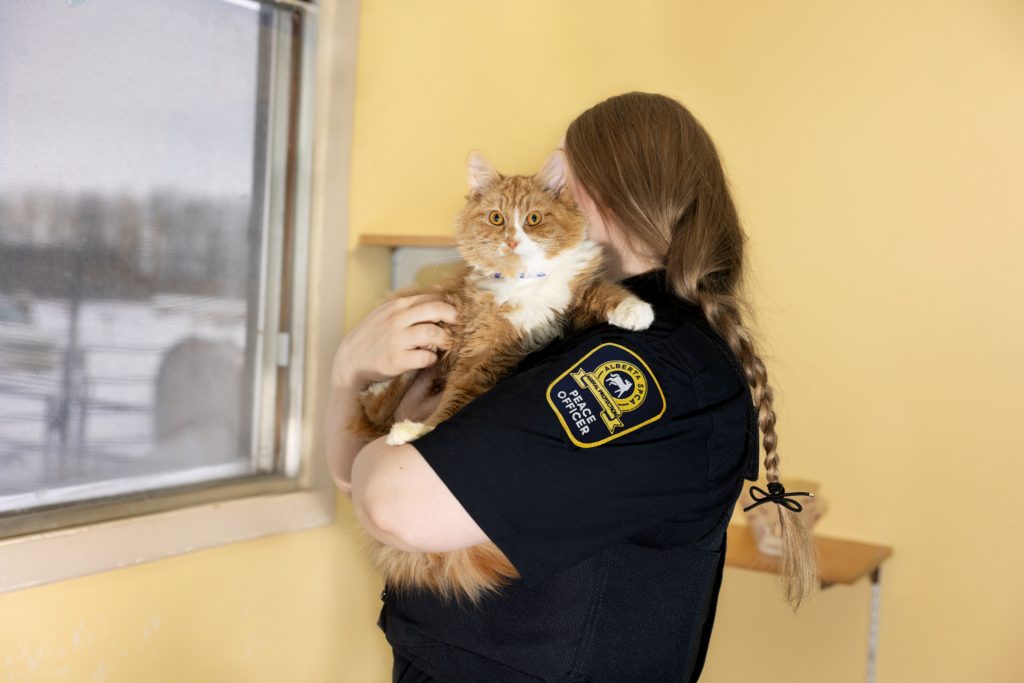
How Does an Animal Welfare Investigation Work?
Working under the Animal Protection Act (APA), our team of peace officers investigates thousands of reports of animals in distress every year. Animal welfare investigations can be complex and lengthy, with numerous steps along the way. Ensuring that laws are followed while keeping animal safety a top priority requires diligent and careful enforcement work.
From the initial report to court proceedings, here’s how an animal welfare investigation is conducted.
A Concern is Reported
First-hand reports of an animal potentially in distress are collected through our Animal Protection Line or online form. All reports are taken seriously; however, our peace officers only respond to first-hand reports of animals potentially in distress. Our peace officers cannot investigate second-hand reports, such as photos viewed online.
The Report is Reviewed
Once a report is created, it is assigned to one of our animal protection officers for review. Based on the details provided the peace officer can investigate the report further, determine the situation does not warrant an investigation or contact other law enforcement authorities should the report fall outside of the scope of the Alberta SPCA; like, concerns about stray animals or improper livestock processing. Some situations may require joint investigations between our peace officers and other agencies.
An Officer Assesses the Situation
Should the report warrant an investigation, our peace officers will attend the location and assess the situation. Typically, this will include contacting the individual who reported the violation for further details, contacting the owners or caregivers of the animals involved and viewing the animals. Peace officers will inspect an animal’s body condition and their environment for signs of distress. All investigations must comply with the inspection powers set out in the Animal Protection Act. Warrants are required to enter private dwellings.
Next Steps
If signs of distress are present, the peace officer may issue a corrective action order outlining improvements required within a specific timeline. Examples include providing better shelter for animals living outdoors or ensuring animals receive veterinary care. This gives the peace officer the opportunity to work with the owner, offering education and potentially avoiding taking animals from their owners. If there is immediate danger present an animal may be seized by the peace officer, or the owner may agree to surrender the animal to the peace officer to prevent or relieve distress.
Follow-Ups
If a corrective action order is issued, the peace officer will conduct a follow-up visit to ensure the conditions have improved. Should the proper changes be made and the animals are free from distress, the investigation is concluded. Further correspondence between the officer and the owner may occur for the ongoing safety of the animals. If issues persist or worsen, further action is taken by the peace officer.
Action
While education and cooperation are key parts of investigations, our peace officers can remove animals. In certain cases, an abandoned animals may be seized to prevent or relieve distress. In some cases, owners may choose to surrender their animals to the peace officer. This may be done to prevent distress , or if the owner will not be able to make the necessary improvements to relieve distress. If, on reasonable and probable grounds, the peace officer believes that the owner will not relieve the distress, they may seize the animal. This is done to protect the animals rather than to punish the caregiver.
Animal Care
Once an animal is seized or surrendered, they are taken to a temporary caregiver or shelter where a veterinarian assesses them. Seizing animals is sometimes necessary to relieve distress, but ensuring proper ongoing care is just as important. Your donations fund over 80% of our work, covering expenses—like veterinary care, shelter and food—for animals removed from distress. Click here to learn how you can help keep animals safe.
Outcomes
Owners have a three-day period (ten if the animal is purebred) to reclaim their animals by covering expenses related to their seizure and care. If the animal is unclaimed after the hold period, the animal is rehomed, typically through an adoption centre. Unfortunately, due to the large number of animals already in temporary care, some animals can wait months before space opens up in an animal adoption centre.
Following an investigation, a peace officer may choose to proceed with either a warning letter or charges under the APA. Should the peace officer choose to proceed with charges, they will prepare a court brief and submit it to the appropriate crown prosecutor.
Court Process
Once the charges have been laid, court proceedings will begin. These may take several months to years.
Should an individual be convicted of offences under the APA, they may receive fines or penalties determined by the court. The Alberta SPCA does not receive any of the fines. Our team works with prosectors to identify appropriate legal outcomes based on the severity of the case. Prohibition orders, which restrict or limit ownership or care of animals, may be issued by the court with advice from the Alberta SPCA. Individuals with outstanding prohibition orders may be inspected by our peace officers to ensure compliance.