
At the Alberta SPCA, we’re committed to continuous learning and collaboration to advance animal welfare across Alberta. After attending our recent Animal Welfare Symposium, Executive Director Leanne Niblock was inspired by a talk from Dr. Ed Pajor on the idea of “wicked problems.” In her message below, she reflects on how this concept can help guide the way we approach complex challenges in our work.
A Message from Our Executive Director
Have you heard of a “wicked problem”? I hadn’t before Dr. Ed Pajor presented on One Health at the University of Calgary at our inaugural Animal Welfare Symposium.
According to Dr. Pajor, wicked problems are socially complex and involve many stakeholders with differing perspectives and expectations. These problems are not easily solved. They often require a shift in thinking — from a focus on finding a solution to committing to continuous intervention. Tackling wicked problems means changing mindsets, habits and behaviours across entire communities.
Dr. Pajor described animal welfare as a wicked problem, and I see his point. However, should we let this overwhelm us and give up on making things better? I don’t think so (and for the record neither does Dr. Pajor) but I do think it should make us think differently about how to approach challenges in our community.
What if we thought of animal welfare not as a problem to solved, but as a verb — actions we take every day to improve lives? What if we focused on root causes, worked collaboratively and aimed for change across systems?
Here’s a great example. Back in 1978, the animal welfare community in Alberta held a similar symposium, hosted by the University of Calgary. Many of the pressing issues discussed then are still with us today. However, one problem did see real progress.
The folks back then thought dog poop in public places was a serious issue. It was both an environmental and health hazard. So, what did they do? The community came together. They worked with many stakeholders to change mindsets, habits and behaviours. They made it easy for dog walkers to get their hands on poop bags. They campaigned to make it socially acceptable to stoop and scoop. They changed bylaws to make it an offense to not clean up dog feces. Problem (pretty much) solved. This shows us change is possible — even on issues that seem entrenched.
We can make a difference. But it takes all of us working together, challenging norms and committing to action. This means we need to get wicked ourselves.
Thanks for everything you do!
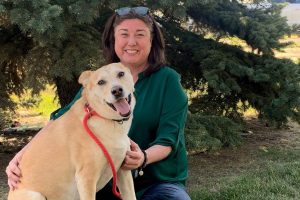
Leanne Niblock, Executive Director, and Hope
Check out our full Fall 2025 AnimalKind Newsletter!